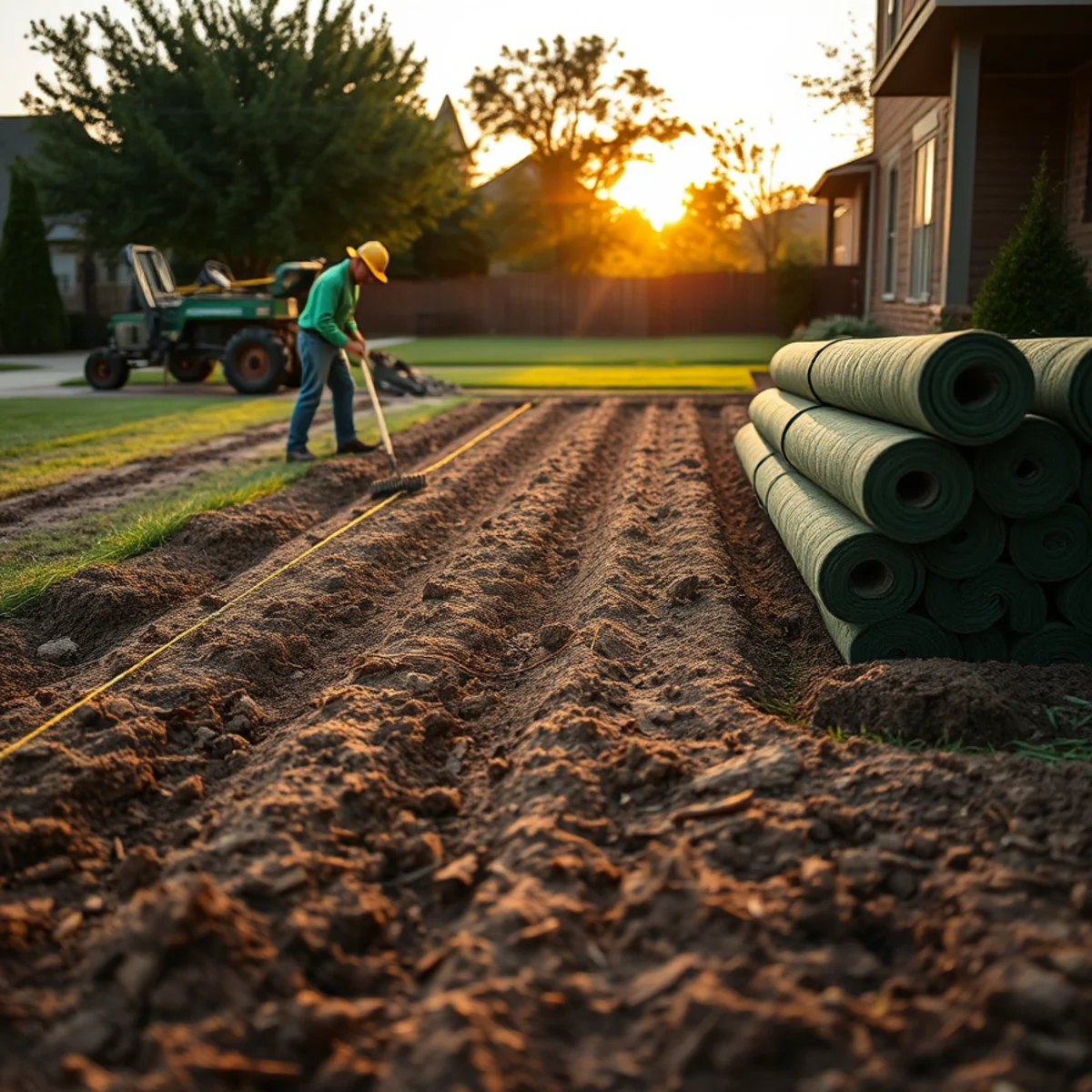
French Drains for Yard Drainage in Fort Worth

If part of your yard turns into a swamp after every storm, you are not imagining it and you are not alone. Across Fort Worth and the wider DFW metroplex, the same culprit shows up again and again: dense, expansive clay soil that refuses to drain. Water pools, lawns thin out, mosquitoes move in, and worst of all, moisture collects against the foundation of your house.
A French drain is one of the most reliable, low-maintenance ways to move that water somewhere safer. Here is how they work, how to tell if you need one, and what a proper installation looks like in North Texas conditions.
Why drainage is so hard in Fort Worth clay soil
Much of Tarrant County sits on heavy expansive clay. Unlike sandy soil, clay does not let water soak through quickly. After a hard spring rain or a North Texas hailstorm, the water has nowhere to go, so it sits on the surface or just below it for days.
That same clay swells when it gets wet and shrinks when it dries out during our long, hot summers. This constant expand-and-contract cycle is rough on everything connected to the ground, including your slab foundation, your sidewalks, and the root zones of mature trees like post oak, live oak, and pecan. Managing where water goes is not just a lawn issue here. It is a home protection issue.
How a French drain actually works
A French drain is deceptively simple. It is a gravel-filled trench with a perforated pipe at the bottom that gives surface and subsurface water an easy path to follow. Water always takes the route of least resistance, and loose gravel plus an open pipe is far easier to travel through than packed clay.
The basic anatomy looks like this:
- A trench dug on a gentle slope so water flows by gravity toward a safe outlet
- A layer of washed gravel that water moves through freely
- A perforated drain pipe at the bottom that collects the water and carries it away
- Filter fabric wrapped around the gravel to keep clay and silt from clogging the system
- An outlet that releases the water at a lower point, such as the street, a drainage easement, a dry well, or a daylight exit at the edge of the property
The whole system relies on slope. Even a small, consistent fall along the length of the trench is enough to keep water moving in the right direction instead of backing up.
Signs you need a French drain
You do not need a soil engineer to spot most drainage problems. Walk your yard a day or two after a good rain and look for these red flags:
- Standing water or squishy, soggy ground that lingers long after the rain stops
- Water pooling against your foundation, slab, or patio instead of draining away
- A persistent low spot or swale where runoff always collects
- Bare patches, moss, or thinning grass in areas that stay wet
- Mosquito breeding and a musty, mildewy smell near the house
- Water seeping into a garage, crawl space, or low-lying flower bed
- Mulch, soil, or gravel that washes out of beds after storms
- Downspouts that dump water right next to the foundation with no path away
If you are checking off several of these, surface grading alone usually will not fix it. A French drain gives the water an engineered path instead of leaving it to find its own.
What a French drain installation involves
A good installation is mostly about planning and slope, not just digging a ditch. Here is the general process we follow on a North Texas property:
- Walk the property and find where water collects, where it comes from, and where it can safely go
- Plan the trench route and outlet so the system drains by gravity to a legal, lower discharge point
- Dig the trench to the proper depth and grade, maintaining consistent slope the whole way
- Line the trench with filter fabric to keep clay and fine silt out of the pipe
- Add a gravel base, lay perforated pipe, then surround it with more washed gravel
- Wrap the fabric over the top and backfill, then restore the surface with soil and sod or gravel as needed
- Clean up and haul away every bit of spoil dirt and debris so the yard looks better than when we started
In clay soil, that filter fabric step is not optional. Skipping it is the single most common reason a cheap French drain clogs and quietly stops working within a couple of seasons. Tying roof downspouts into the system, where it makes sense, also keeps a huge volume of water from ever reaching the foundation in the first place.
Protecting your foundation and your trees
The biggest payoff of good drainage in Fort Worth is foundation protection. When water repeatedly pools against a slab, the surrounding clay goes through extreme wet-dry swings. That uneven movement is a leading cause of foundation cracks and settling in DFW homes, and foundation repair costs far more than drainage work ever will.
Drainage also matters for your trees. Native species like live oak, cedar elm, and bur oak are adapted to our climate, but their roots still suffer when the soil stays waterlogged for long stretches. Chronically saturated soil starves roots of oxygen and invites root rot. Moving standing water away from the root zone keeps mature trees healthier through both our wet springs and our dry summers.
What affects the cost of a French drain
Every yard is different, so honest pricing depends on the specifics rather than a one-size figure. The main factors that move the price are:
- The length of the drain run and how deep the trench needs to be
- How hard the clay or rock is to dig in that part of the property
- Where the water can legally discharge and how far away that outlet is
- Whether downspouts, catch basins, or a dry well are tied into the system
- Obstacles like tree roots, sprinkler lines, utilities, hardscape, or existing landscaping
- How much sod, soil, or gravel is needed to restore the surface afterward
At Sion Tree Service, we walk your property, find the real source of the water, and give you a clear, honest estimate where the quoted price is the final price. No surprise add-ons, and we leave the site clean like we were never there.
Get a free drainage estimate
If your Fort Worth yard floods, stays soggy, or sends water toward your foundation, a properly built French drain can solve it for good. Sion Tree Service is a locally owned, licensed, and insured company serving Fort Worth and the DFW metroplex, open daily from 6 AM to 7 PM with fast, often same-day or next-day response. Call (208) 635-2100 for a free, no-pressure estimate and let us get the water moving the right way.
Keeping a French drain working through North Texas seasons
A French drain is low-maintenance, not no-maintenance. The good news is that a properly built system with filter fabric and a clean outlet asks very little of you. The bad news is that the few things it does need tend to get ignored until the yard floods again, and by then clay silt has often already migrated into the pipe. A quick walk-through once a year, ideally before our wet spring season ramps up in March and April, catches almost every problem early.
Here is what to keep an eye on between Fort Worth's heavy spring rains and long dry summers:
- Walk the outlet after a storm and make sure water is actually running out of it. A daylight exit buried under leaves, grass clippings, or washed-in mulch will back the whole system up.
- Ask for a cleanout riser at the high end of the run when the drain goes in. A simple capped vertical pipe lets a plumber or your installer flush the line with a hose or jetter instead of digging it up.
- Watch for slow drainage or surface pooling that returns even though nothing else changed. That usually means clay silt has started coating the pipe, and a flush is cheaper than a redo.
- Keep catch-basin inlets free of standing water. Sitting water in a basin is a mosquito nursery in our long warm season, so a basin that holds water for days after a storm is telling you it is not draining.
- Mind the freeze risk during events like the February 2021 cold snap. Still water and trapped silt freeze and expand inside a pipe far more easily than moving water, which is one more reason to keep the line clear and flowing.
None of this is glamorous, but it is the difference between a drain that quietly works for decades and one that clogs out in a couple of seasons. In our clay, silt management is the whole game.
When a French drain is not the right tool
A French drain is built to collect water spread across saturated ground and water sitting just below the surface. It is not the best answer for every drainage problem, and a good installer will tell you when something else fits better. Pushing a French drain at a job it was not designed for is how people end up paying twice.
A few situations where a different approach, or a combination, makes more sense in DFW yards:
- A single hard low spot or a patio that sheets a large volume of water fast is often better served by a catch basin and solid pipe, which swallow surface runoff quicker than a perforated drain can.
- Water coming off a roof is best handled by tying buried downspout lines straight to an outlet, keeping that concentrated volume out of the gravel system entirely.
- A gentle drainage path across an open lawn can sometimes be solved with a shallow graded swale that simply carries water to a lower point, no trench or gravel required.
- Driveways, sidewalks, and other hardscape that channels water usually need a surface inlet or channel drain at the edge rather than a buried perforated line.
In practice, the most reliable setups on Fort Worth clay are hybrids. A French drain pulls the slow, saturated subsurface water while catch basins grab the fast surface runoff and downspout lines keep roof water out of the equation, all tied to one legal outlet. The right mix depends on where your water actually comes from, which is why the first step on any property is walking it and tracing the water before anyone picks up a shovel.
FAQs
A properly installed French drain with quality filter fabric and washed gravel can last for decades. The key in our heavy clay is the fabric that keeps silt out of the pipe. Skip that step and a cheap drain can clog within a couple of seasons, which is why proper installation matters more here than almost anywhere.
Yes, that is one of its biggest benefits in DFW. By moving water away from your slab, a French drain reduces the extreme wet-dry swelling and shrinking of clay soil that leads to foundation cracks and settling. Tying in your downspouts adds even more protection by keeping roof runoff away from the house.
Most basic residential French drains that discharge on your own property do not require a permit, but rules vary by city and you cannot legally direct water onto a neighbor's property. We plan every drain to discharge to a safe, legal outlet and will let you know if your specific situation calls for anything extra before we start.
If your installer left a cleanout riser at the high end of the run, the line can usually be flushed with a garden hose or a plumber's jetter without any digging. In Fort Worth clay the usual culprit is fine silt coating the perforated pipe, so flushing from the high point pushes that sediment toward the outlet. If there is no cleanout and the drain has fully silted in, a section may need to be excavated and the fabric and gravel replaced.
Yes, and tying downspouts in is one of the smartest moves you can make on a North Texas property. It keeps a large concentrated volume of roof water from ever reaching your foundation. That said, heavy roof runoff is usually carried in solid pipe to the outlet rather than dumped into the gravel, so the perforated drain stays focused on the slower ground water it was built to collect.
It can, which is exactly why a basin or inlet should never hold water for long. In our warm DFW season a catch basin that stays wet for days after a storm is both a mosquito breeding site and a sign the system is not draining the way it should. A properly sloped drain empties its inlets within hours, so lingering water is your cue to check the outlet and the line for a clog.